
How Running Gait Analysis Improves Race Performance
You have the mileage in your legs and the training plan on your phone. But something still feels off: a nagging hip, a pace that will not budge, or the same injury resurfacing every few months.
Because it’s so easy to go to a running store, buy some shoes and start running, most people never work on the skill of running better. Moreover, most runners have never had a proper running gait analysis.
A running gait analysis gives you an objective look at your biomechanics and shows exactly what is limiting your performance or putting you at risk.
What Is a Running Gait Analysis?
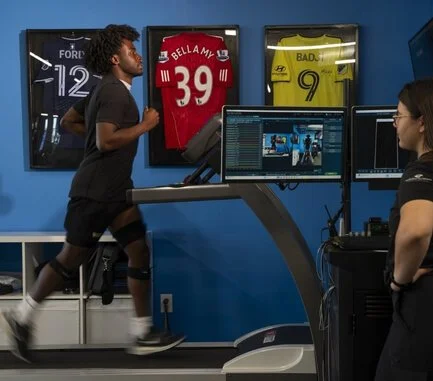
A running gait analysis is a structured, 3D sensor and video-based assessment of your running mechanics. A clinician evaluates how you move from foot strike to toe-off, looking at every joint and segment along the way.
At Studholme Chiropractic, we use functional performance tools to assess:
Foot strike pattern: where and how your foot contacts the ground
Cadence: steps per minute and how it affects joint load
Hip drop and pelvic stability: a common driver of IT band and knee pain
Knee drive and arm swing: how well your upper and lower body coordinate
Trunk lean and posture: where you are losing or wasting energy
Ankle stiffness and push-off: a major factor in running economy
The goal is to find which compensations are costing you performance or setting you up for injury.
What Gait Analysis Reveals About Your Running Form
Overstriding
Landing with your foot ahead of your hips puts a braking force on every stride. A cadence increase of just 5 to 10 percent often corrects this and immediately improves efficiency.
Asymmetry
When one side compensates for weakness or restriction on the other, imbalances build under fatigue. Left unaddressed, this pattern leads to IT band syndrome, plantar fasciitis, and stress fractures.
Root-Cause Weaknesses
A knee collapsing inward usually points to hip abductor weakness. Excessive forward lean often reflects limited ankle dorsiflexion. Knowing the source makes corrective work targeted, not generic.
Fatigue-Related Breakdown
Some patterns only show up when you are tired. Knowing where your form falls apart in the final miles helps you train the muscles that hold up when it matters most.
How Gait Analysis Improves Performance
Running economy, meaning how efficiently you use oxygen at a given pace, is one of the strongest predictors of endurance performance. Two runners with identical VO2 max scores can have very different race times based on how economically they move.
A gait analysis improves performance by:
Reducing energy leakage from poor posture and excessive bounce
Improving stride efficiency through better foot strike and cadence
Allowing harder training by eliminating pain-causing patterns
Targeting the specific weaknesses holding your mechanics back
For runners building toward a marathon, these improvements compound across a full training block. Our marathon training guide covers how to pair mechanics improvements with smart mileage progression. And if you want to understand how running economy and VO2 max interact, our post on VO2 max training zones breaks it down.
How Gait Analysis Prevents Running Injuries
Between 50 and 80 percent of runners get injured every year. Most of those injuries are overuse problems, not freak accidents, and most trace back to movement patterns that have gone unaddressed.
A gait analysis identifies those patterns before they become injuries:
Excessive hip drop correlates with IT band syndrome and patellofemoral pain
Overstriding increases load on the knee and lower back
Poor ankle mobility shifts stress onto the Achilles and plantar fascia
For more on managing training load alongside mechanics, see our guide on how to prevent running injuries and the deeper look at the science behind running analysis and injury prevention.
What to Expect After Your Running Gait Analysis
Findings feed directly into a targeted plan that typically includes:
Mobility work for restrictions in the ankles, hips, or thoracic spine
Strengthening protocols for the muscles driving your compensations
Form coaching to help new movement patterns stick during runs
Chiropractic adjustments to address joint restrictions and asymmetry
Training modifications to keep you moving while injuries resolve
The goal is not a perfect gait. It is a gait that is efficient, durable, and matched to the demands you are placing on your body.
Who Should Get a Running Gait Analysis?
A gait analysis is worth it if you:
Have a recurring injury that keeps coming back despite rest
Are stuck at a performance plateau with no clear reason why
Are building mileage for a race and want to stay healthy doing it
Recently changed shoes, surfaces, or training and are feeling it
Are returning from injury and want to avoid the same pattern
You do not need to be fast to benefit from running efficiently. Elite runners get assessed regularly, and recreational athletes gain from the same information.
Book a Running Gait Analysis in Denver
Studholme Chiropractic serves runners across Denver, Englewood, Littleton, Cherry Hills Village, and the Front Range. We work with trail runners, road racers, triathletes, and everyday athletes who want to run well for the long term.
Contact us today to book your running gait analysis, or explore our full performance services.